

Prestige Gleam
Scalp Treatment: Differences Between a Healthy and Poor Scalp
Sep
Prestige Gleam helps beauty shoppers explore hair care, skincare, makeup, scalp-care products, and personal-care essentials. A scalp treatment can be useful when the scalp feels dry, oily, flaky, itchy, or affected by product buildup. However, the right treatment depends on what is actually causing the problem.
The difference between a healthy scalp and a problematic scalp is not simply whether it looks clean. For example, dandruff is not necessarily caused by poor hygiene. The American Academy of Dermatology explains that dandruff can have several causes, including oily skin, hair-care habits, and certain medical conditions.
Therefore, good scalp care starts with identifying symptoms rather than aggressively scrubbing or applying multiple treatments.
This guide explains what does a scalp treatment do, the benefits of scalp treatment, what is a scalp treatment at a salon, deep conditioning, and the differences between a comfortable scalp and one showing signs of irritation. In addition, we cover waterproof mascara for beach days, including long lasting waterproof mascara, waterproof lengthening mascara, waterproof volume mascara, and current Allure best mascara options.
What Is a Scalp Treatment?
A scalp treatment is a product or service designed to address the scalp rather than simply the hair lengths.
Depending on the treatment, its purpose may include:
- Removing excess oil
- Loosening flakes
- Reducing product buildup
- Cleansing the scalp
- Supporting moisture
- Improving scalp comfort
- Addressing dandruff
- Preparing the scalp for shampooing
- Supporting an overall hair-care routine
However, “scalp treatment” is a broad term.
A clarifying scalp cleanser and a medicated dandruff shampoo, for example, perform very different jobs.
Therefore, choose according to your scalp concern.
What Does a Scalp Treatment Do?
If you are wondering what does a scalp treatment do, start with the specific product.
A moisturizing treatment may help a dry-feeling scalp.
Meanwhile, a dandruff treatment may contain active ingredients designed to control dandruff.
An exfoliating treatment may help loosen surface buildup.
Similarly, a clarifying product may help remove excess styling-product residue.
However, no single scalp treatment solves every scalp problem.
The American Academy of Dermatology’s scalp-care resources explain that different scalp conditions require different approaches.
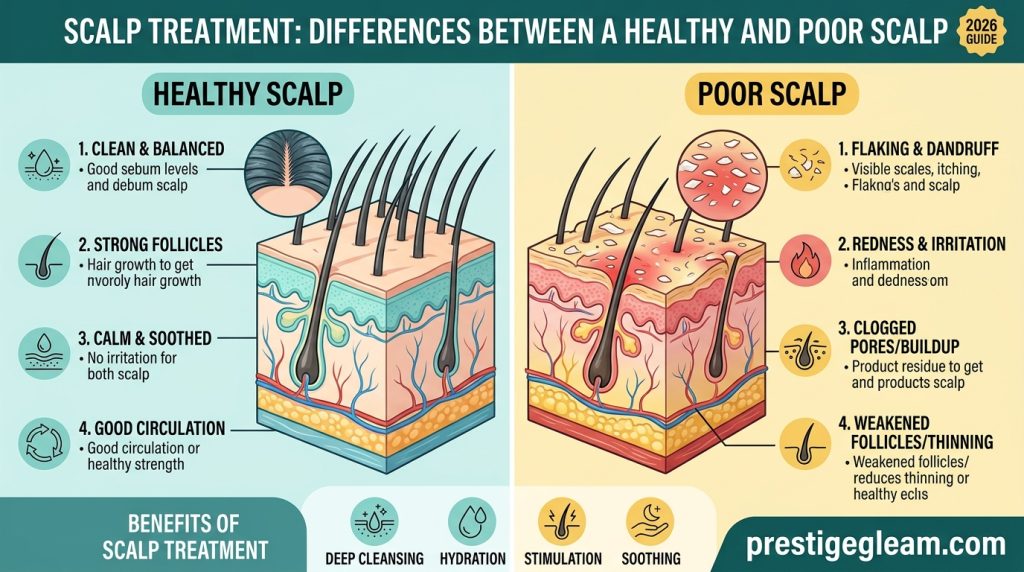
Healthy Scalp vs Poor Scalp
It is more accurate to describe a scalp as comfortable or showing signs of a problem rather than simply “good” or “bad.”
A comfortable scalp generally does not have persistent:
- Intense itching
- Burning
- Pain
- Heavy flaking
- Open sores
- Bleeding
- Significant redness
- Unexplained hair loss
- Thick scaling
- Recurrent inflammation
Meanwhile, a scalp with persistent symptoms may need targeted care.
However, visible oil alone does not automatically mean the scalp is unhealthy.
Likewise, occasional dryness does not automatically indicate disease.
What Does a Healthy Scalp Look Like?
A comfortable scalp generally feels normal during everyday activities.
You should not constantly feel the need to scratch it.
In addition, routine washing should not repeatedly cause burning or significant irritation.
Some natural oil is normal because the scalp contains sebaceous glands.
Therefore, trying to remove every trace of oil can be counterproductive.
Instead, cleanse according to your hair type, scalp needs, styling routine, and product use.
Signs Your Scalp May Need Attention
Persistent symptoms deserve more attention.
For example:
Frequent itching may indicate dandruff, irritation, product sensitivity, or another scalp condition.
Heavy flaking may result from dandruff, dry skin, seborrheic dermatitis, psoriasis, or another cause.
Burning can sometimes occur after irritating products or chemical services.
Persistent redness can indicate irritation or inflammation.
Sores or bleeding should not simply be covered with styling products.
Unexplained hair loss may need professional evaluation.
The AAD explains that dandruff, dry scalp, psoriasis, eczema, fungal infections, and other conditions can produce overlapping symptoms.
Therefore, avoid diagnosing every flaky scalp as dandruff.
Dry Scalp vs Dandruff
These conditions can look similar.
However, they are not necessarily the same.
According to the American Academy of Dermatology, dry scalp can occur when the skin loses too much water. Meanwhile, dandruff is often associated with other factors, including oily skin and seborrheic dermatitis.
Both can cause itching and flakes.
Therefore, identifying the underlying issue matters.
A product designed for dandruff may not be the ideal solution for simple dryness.
What Causes a Poor-Feeling Scalp?
Several factors can contribute to scalp discomfort.
For example:
- Product buildup
- Dandruff
- Dryness
- Excess oil
- Product irritation
- Inadequate rinsing
- Chemical processing
- Psoriasis
- Seborrheic dermatitis
- Eczema
- Certain infections
Interestingly, even shampoo residue can cause problems.
The AAD notes that leaving shampoo on the scalp can contribute to itching, dryness, and flaking.
Therefore, rinse thoroughly.
Benefits of Scalp Treatment
The benefits of scalp treatment depend entirely on the treatment used.
For example, an appropriate treatment may help:
- Control dandruff
- Remove excess product residue
- Improve scalp cleanliness
- Reduce an excessively oily feel
- Support moisture
- Loosen surface flakes
- Improve comfort
- Complement shampooing
However, avoid exaggerated claims.
A cosmetic scalp treatment should not automatically be described as curing hair loss, psoriasis, eczema, fungal infection, or another medical condition.
Instead, choose products according to their intended use.
Scalp Treatment for Dandruff
Dandruff is one area where treatment selection matters.
The AAD lists several active ingredients commonly found in dandruff shampoos, including:
- Zinc pyrithione
- Salicylic acid
- Sulfur
- Selenium sulfide
- Ketoconazole
- Coal tar
Different formulas require different application methods.
For example, some dandruff shampoos need to remain on the scalp for several minutes before rinsing.
Therefore, follow the product label rather than assuming every shampoo should be used identically.
You can review the complete recommendations through the American Academy of Dermatology dandruff guide.
Should You Exfoliate Your Scalp?
Scalp exfoliation has become popular.
However, more exfoliation does not automatically produce a healthier scalp.
Some products use physical particles, while others use chemical exfoliating ingredients.
If your scalp is already irritated, aggressive scrubbing can make discomfort worse.
Therefore, use scalp exfoliating products according to their directions.
In addition, stop if a product causes significant burning, persistent redness, or worsening irritation.
What Is a Scalp Treatment at a Salon?
People asking what is a scalp treatment at a salon may encounter several different services.
A salon scalp treatment can potentially include:
- Scalp consultation
- Hair and scalp cleansing
- Scalp massage
- Exfoliation when appropriate
- Specialized shampoo
- Conditioning
- Scalp-focused product application
- Rinsing
- Styling
However, there is no universal salon scalp-treatment protocol.
One salon may focus on relaxation and cleansing. Meanwhile, another may offer products for oiliness or dandruff.
Therefore, ask what the service actually includes before booking.
Salon Scalp Treatment vs Medical Scalp Treatment
This distinction is important.
A salon service is generally cosmetic.
It may help with cleansing, conditioning, buildup, or appearance.
However, a hairstylist does not replace a dermatologist for persistent medical scalp problems.
Consider medical evaluation if you experience significant:
- Hair loss
- Pain
- Bleeding
- Open sores
- Persistent severe itching
- Thick scales
- Significant inflammation
- Signs of infection
The AAD recommends seeing a dermatologist when dandruff remains severe or does not improve with appropriate home treatment.
Can Scalp Treatments Help Hair Grow?
Be careful with claims about hair growth.
Keeping the scalp appropriately clean and managing scalp conditions can support a healthy hair-care environment.
However, that does not mean an ordinary cosmetic scalp treatment can reverse every form of hair loss.
Hair loss can have many causes.
Therefore, persistent or unexplained shedding deserves appropriate evaluation.
How Often Should You Get a Scalp Treatment?
There is no universal schedule.
Frequency depends on:
- Treatment type
- Scalp condition
- Hair texture
- Oil production
- Styling habits
- Product buildup
- Washing frequency
- Manufacturer instructions
Therefore, do not assume weekly treatment is necessary for everyone.
Some people may only need regular shampooing and conditioning.
Meanwhile, someone managing dandruff may need a specific treatment schedule.
Scalp Treatment for Oily Hair
An oily scalp does not necessarily mean poor hygiene.
Oil production varies naturally.
In addition, styling products can contribute to buildup.
Therefore, appropriate cleansing can help.
The AAD notes that people with fine or straight hair and oily scalps may need more frequent shampooing than people with coarse, curly, or coily hair.
Consequently, washing frequency should reflect individual hair and scalp needs.
Scalp Treatment for Curly and Coily Hair
Curly and coily hair may require a different approach.
For example, strong dandruff shampoos can dry the hair lengths.
The AAD advises people with curly or coily hair using dandruff shampoo to concentrate the product on the scalp. Normal shampoo and conditioner can then be used as needed for the hair.
Therefore, treating the scalp does not mean neglecting the hair.
What Does Deep Conditioning Do?
What does deep conditioning do?
Deep conditioner generally provides more intensive cosmetic conditioning than a basic everyday conditioner.
Depending on the formula, it may help hair feel:
- Softer
- Smoother
- More manageable
- Easier to detangle
- Less rough
- Better lubricated
However, deep conditioner does not permanently rebuild every type of damaged hair.
Hair that has been heavily bleached, chemically processed, or repeatedly exposed to excessive heat can still have structural damage.
Therefore, deep conditioning should be viewed primarily as a conditioning and manageability step.
Scalp Treatment vs Deep Conditioning
These products target different areas.
Scalp treatment → primarily targets the scalp.
Deep conditioner → primarily conditions the hair.
However, some products may be designed for both.
Therefore, read the instructions.
Do not automatically apply a rich hair mask directly to the scalp if the manufacturer recommends using it only through the lengths and ends.
How to Use Deep Conditioner
If you are wondering how to use deep conditioner, begin with the manufacturer’s instructions.
A general routine often looks like this:
- Shampoo the hair.
- Rinse thoroughly.
- Remove excess water when appropriate.
- Apply deep conditioner according to the label.
- Concentrate on the areas that need conditioning.
- Leave it on for the recommended time.
- Rinse thoroughly if it is a rinse-out product.
However, leaving a conditioner on much longer than instructed does not automatically improve results.
Instead, follow the recommended timing.
How Often Should You Deep Condition?
Again, there is no universal schedule.
Dry, curly, coily, color-treated, or frequently styled hair may benefit from more intensive conditioning.
However, fine hair may become weighed down by very rich products.
Therefore, adjust frequency according to your hair and the formula.
Deep Conditioner for Chemically Treated Hair
Hair that has been bleached, colored, relaxed, or chemically processed may feel drier or rougher.
Consequently, conditioning can become especially useful.
However, avoid assuming that a mask can reverse all chemical damage.
Instead, combine appropriate conditioning with gentler styling practices.
In addition, reduce unnecessary high-temperature styling.
Scalp Massage During Treatment
Scalp massage is commonly included in salon treatments.
It can make the service feel relaxing and help distribute products.
However, aggressive scratching is unnecessary.
Use fingertips rather than sharp nails.
Furthermore, avoid vigorous massage over irritated, inflamed, or injured areas.
Waterproof Mascara and Beach Beauty
Scalp treatment may be the primary topic, but many beauty shoppers also search for best mascara for the beach.
Beach makeup creates a different challenge because of:
- Water
- Sweat
- Humidity
- Heat
- Sunscreen
- Long wear
Therefore, a waterproof or highly water-resistant mascara can be more practical than a conventional formula.
Best Mascara for the Beach
The best mascara for the beach depends on the look you want.
For example, one person may prioritize volume.
Meanwhile, another may prefer length.
Someone with straight lashes may focus on curl retention.
Most importantly, even waterproof mascara is not indestructible.
Allure’s August 2026 waterproof-mascara testing notes that waterproof formulas can resist moisture, humidity, sweat, and some water exposure, although even strong formulas are not guaranteed to withstand unlimited swimming or ocean exposure.
Long Lasting Waterproof Mascara
A long lasting waterproof mascara should provide reasonable resistance to moisture without requiring aggressive rubbing during removal.
Current Allure testing includes several long-wearing options for different lash goals.
For beach use, consider:
- Water resistance
- Smudge resistance
- Lash separation
- Desired volume
- Desired length
- Curl retention
- Ease of removal
However, never sacrifice eye comfort simply for longer wear.
Waterproof Lengthening Mascara
A waterproof lengthening mascara focuses on making lashes appear longer while maintaining moisture resistance.
In Allure’s current 2026 waterproof-mascara guide, Caliray Come Hell or High Water is highlighted for lengthening. However, Allure also notes that its tubing formula is not completely waterproof in the same way as some traditional waterproof formulas.
Therefore, consider your expected level of water exposure.
A humid beach walk is different from spending hours swimming.
Waterproof Volume Mascara
A waterproof volume mascara focuses on creating fuller-looking lashes.
Allure’s current 2026 testing highlights Clinique High Impact High-Fi Full Volume Waterproof Mascara as its volumizing selection.
However, individual results depend on natural lashes, application technique, and desired finish.
Therefore, treat editorial awards as useful product-testing information rather than a guarantee that one mascara is ideal for everyone.
Waterproof Curling Mascara
A waterproof curling mascara can be useful for people whose lashes tend to fall straight.
Waterproof formulas may sometimes hold curl better because of their film-forming characteristics.
Allure’s current waterproof mascara guide notes that waterproof formulas can be particularly useful for maintaining curl.
However, avoid repeatedly layering mascara until lashes become excessively stiff.
Instead, build gradually.
Allure Best Mascara
People searching Allure best mascara or Allure top mascara should consider the date of the article.
Beauty recommendations change as formulas launch, reformulate, or disappear.
As of August 2026, Allure’s waterproof mascara guide highlights:
- Lancôme Lash Idôle Waterproof Mascara for its overall selection
- Clinique High Impact High-Fi Full Volume Waterproof Mascara for volume
- Maybelline Lash Sensational Body Waterproof Mascara for lifting
- Caliray Come Hell or High Water for lengthening
- L’Oréal Paris Voluminous Waterproof Mascara as a drugstore selection
You can review the current Allure waterproof mascara guide.
Allure Top Mascara vs Your Best Mascara
An editorial recommendation is useful, but mascara is highly personal.
For example, consider:
Short lashes: prioritize length.
Sparse lashes: prioritize volume.
Straight lashes: prioritize lift and curl retention.
Beach use: prioritize water and smudge resistance.
Sensitive eyes: prioritize compatibility and comfort.
Therefore, an Allure top mascara may be a strong starting point without automatically being the perfect mascara for you.
Waterproof Mascara Safety
Eye makeup requires careful hygiene.
The FDA advises consumers to wash their hands before applying eye cosmetics, avoid sharing mascara, keep applicators clean, and stop using products that cause irritation.
In addition, do not add water or saliva to dried mascara.
The FDA warns that doing so can introduce microorganisms and interfere with the preservative system.
For complete guidance, see the FDA Eye Cosmetic Safety guide.
How to Remove Waterproof Mascara
Waterproof formulas may require more careful removal than conventional mascara.
Avoid repeatedly pulling at the lashes.
Instead, use an appropriate eye-makeup remover according to its directions and allow it time to loosen the formula.
Allure’s current guide also notes that excessive rubbing and pulling during removal can contribute to lash breakage.
Therefore, durability during the day should be balanced with gentle removal at night.
What Is the Top Rated Skin Care Line?
The question what is the top rated skin care line does not have one objective answer.
Ratings can measure different things:
- Dermatologist recommendations
- Customer reviews
- Editorial testing
- Sales
- Ingredient quality
- Luxury positioning
- Value
- Sensitive-skin suitability
- Anti-aging performance
Therefore, there is no scientifically established single number-one skincare line for everyone.
Instead, compare individual products.
For example, your ideal cleanser, moisturizer, serum, and sunscreen do not need to come from the same company.
Choosing a Good Skincare Line
Rather than chasing a ranking, ask whether a skincare line offers products appropriate for your needs.
Look for:
- Clear directions
- Useful ingredients
- Appropriate textures
- Transparent labeling
- Products suitable for your skin type
- Realistic cosmetic claims
- Reliable sun protection when applicable
- Reasonable pricing for your budget
In addition, avoid assuming expensive products automatically perform better.
Consistency and compatibility matter greatly.
Scalp Care, Hair Care and Skin Care Work Differently
The scalp is skin, but scalp care has unique considerations because hair grows through it and hair-care products frequently contact it.
Therefore, a facial skincare routine should not simply be copied onto the scalp.
For example, a facial exfoliating acid is not automatically suitable for scalp use.
Likewise, a scalp treatment should not automatically be used on facial skin.
Instead, use products for their intended area.
Where to Buy Scalp Treatment and Beauty Products
Prestige Gleam gives shoppers a place to explore hair care, scalp-care products, skincare, makeup, mascara, beauty tools, and personal-care products.
When exploring scalp products through Prestige Gleam, first identify whether your goal is cleansing, moisture, dandruff control, buildup removal, or general hair-care maintenance.
Meanwhile, people shopping for mascara should compare waterproof performance, length, volume, curl, brush design, and removal method.
For evidence-based scalp information, the American Academy of Dermatology provides useful dermatologist-reviewed resources. For eye-makeup safety, consult the FDA Eye Cosmetic Safety guidance.
Frequently Asked Questions
What does a scalp treatment do?
It depends on the treatment. A product may cleanse the scalp, control dandruff, reduce buildup, support moisture, or improve scalp comfort.
What are the benefits of scalp treatment?
Potential benefits include improved cleansing, dandruff management, reduced buildup, improved comfort, and better moisture balance. However, benefits depend on the product and underlying scalp condition.
What is a scalp treatment at a salon?
A salon treatment may include consultation, cleansing, massage, exfoliation, specialized shampoo, conditioning, and other cosmetic scalp-care steps. However, services vary by salon.
What is the difference between a healthy scalp and a poor scalp?
A comfortable scalp generally lacks persistent severe itching, pain, heavy scaling, sores, bleeding, or significant inflammation. However, symptoms can have many causes and should not be diagnosed by appearance alone.
Is dandruff caused by poor hygiene?
Not necessarily. The AAD explains that dandruff can be associated with oily skin, hair-care habits, and certain medical conditions.
Can scalp treatments stop hair loss?
Ordinary cosmetic scalp treatments should not be assumed to stop every form of hair loss. Persistent or unexplained shedding may require professional evaluation.
What does deep conditioning do?
Deep conditioning can improve softness, lubrication, manageability, and the feel of dry or rough hair. However, it does not permanently reverse every form of structural damage.
How do you use deep conditioner?
Generally, shampoo first, apply the conditioner according to its instructions, leave it on for the recommended period, and rinse if it is a rinse-out formula.
What is the best mascara for the beach?
Look for a water-resistant or waterproof formula suited to your desired length, volume, and curl. Current Allure testing includes several options designed for moisture resistance.
What is a good long lasting waterproof mascara?
Current Allure testing highlights Lancôme Lash Idôle Waterproof Mascara as its overall waterproof selection, although individual preferences vary.
What is a waterproof lengthening mascara?
It is a mascara designed to create the appearance of longer lashes while providing increased moisture resistance.
What is a waterproof volume mascara?
It combines moisture resistance with a formula and brush intended to create fuller-looking lashes.
What is a waterproof curling mascara?
It is designed to help define lashes while supporting a lifted or curled appearance and resisting moisture.
What is Allure’s best waterproof mascara?
As of its August 2026 guide, Allure lists Lancôme Lash Idôle Waterproof Mascara as its overall waterproof selection.
Is waterproof mascara completely waterproof?
Not necessarily. Current Allure expert guidance notes that many waterproof mascaras are more accurately highly water-resistant and may not withstand unlimited swimming or prolonged water exposure.
What is the top rated skin care line?
There is no universal top-rated skincare line. Instead, compare individual products based on skin type, ingredients, evidence, tolerability, price, and intended use.
Final Thoughts
Understanding scalp treatment and the differences between a good and poor scalp starts with recognizing that scalp health cannot be judged simply by oiliness or occasional flakes.
Instead, pay attention to persistent symptoms.
A comfortable scalp generally should not cause constant itching, burning, pain, significant inflammation, sores, or heavy scaling. Meanwhile, dandruff, dry skin, product irritation, seborrheic dermatitis, psoriasis, eczema, and other conditions can produce overlapping symptoms. The American Academy of Dermatology’s scalp-care resources provide dermatologist-reviewed information for understanding these differences.
Similarly, deep conditioning serves a different purpose. It primarily conditions the hair rather than treating the scalp. Therefore, use each product on the area and for the purpose recommended by its manufacturer.
For beach beauty, a long lasting waterproof mascara can help resist moisture, sweat, and humidity. However, even strong waterproof formulas are not invincible during prolonged swimming. Current Allure waterproof mascara testing provides useful comparisons for lengthening, volume, lifting, and long wear.
Finally, use mascara hygienically and remove it gently. The FDA advises against sharing eye cosmetics or adding water or saliva to dried mascara.
Explore scalp care, hair treatments, skincare, waterproof mascara, and other beauty essentials through Prestige Gleam.
