

Prestige Gleam
Key Importance of Water-Based Body Lotion, Vitamin C Face Cream and Anti-Aging Body Creams
Oct
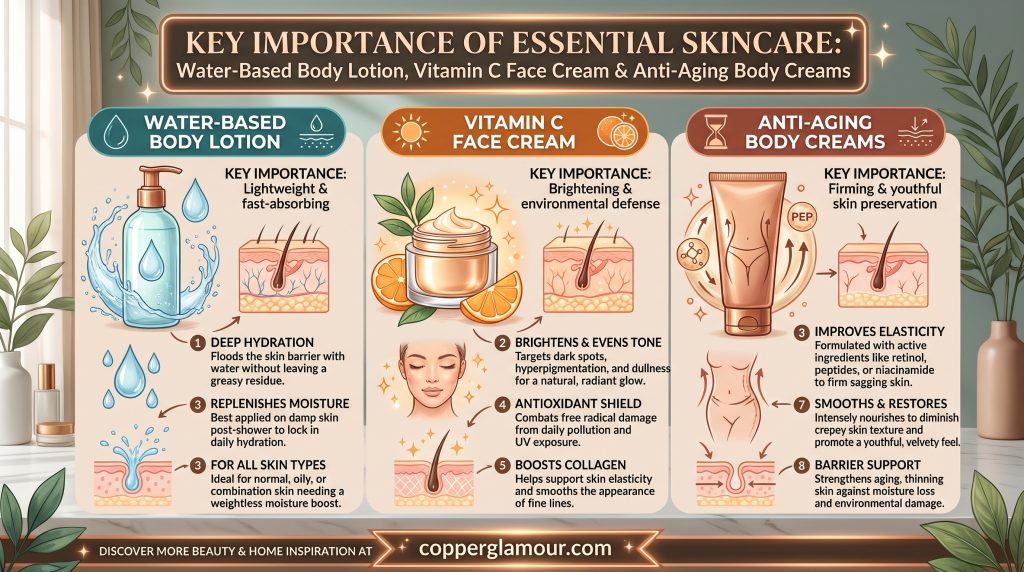
Prestige Gleam helps beauty shoppers discover skincare products, facial moisturizers, body lotions, and anti-aging beauty essentials. Understanding the importance of water-based body lotion, vitamin C face cream, and anti-aging body creams can help you build a skincare routine that supports hydration, smoother-looking skin, and a more radiant complexion.
Although these products share some benefits, they serve different purposes. A water-based lotion generally provides lightweight hydration, while vitamin C face cream focuses on moisturizing and supporting a more even-looking complexion. Meanwhile, anti-aging body creams often combine moisturizing ingredients with other components designed to improve the appearance of dryness, roughness, and fine lines.
However, no single product can stop natural aging. Instead, effective skincare combines suitable ingredients, consistent moisturizing, sun protection, and realistic expectations.
This guide explains the benefits of water-based moisturizers, vitamin C facial lotions, hyaluronic acid, nighttime creams, and body products for aging skin.
What Is Water-Based Body Lotion?
A water-based body lotion is a moisturizing product in which water generally forms a major part of the formulation.
These lotions commonly combine water with humectants, emollients, and other ingredients that help skin feel hydrated and comfortable.
Unlike some heavier body creams, water-based lotions often have a lighter texture. Therefore, they can be particularly appealing to people who dislike a thick or greasy finish.
However, water-based does not mean oil-free. Many effective water-based moisturizers also contain oils, silicones, or other emollient ingredients.
Key Benefits of Water-Based Body Lotion
- Helps maintain skin hydration.
- Can feel lightweight and comfortable.
- May absorb with less greasy residue, depending on the formula.
- Supports softer, smoother-feeling skin.
- Can be suitable for everyday use.
- May work well in warm or humid climates.
- Provides a convenient moisturizing option after bathing.
In addition, water-based lotions can suit people who prefer applying moisturizer over larger body areas without a heavy finish.
Why Water-Based Lotion Is Important for Skin Hydration
Skin naturally loses water through its outer layers.
Consequently, dryness may become more noticeable when the skin barrier is disrupted or environmental conditions increase moisture loss.
A well-formulated water based lotion can help by combining several ingredient types.
Humectants, such as glycerin and hyaluronic acid, attract and retain water.
Emollients help improve skin softness and smoothness.
Occlusive ingredients help reduce moisture loss.
Therefore, the complete formulation matters more than the presence of water alone.
A lotion containing only water would not provide the same moisturizing benefits as a balanced formula.
Water-Based Body Lotion vs Body Cream
The main difference is often texture and richness.
| Feature | Water-based body lotion | Rich body cream |
|---|---|---|
| Texture | Often lightweight | Usually thicker |
| Finish | May feel less greasy | Often more protective |
| Best suited for | Normal skin and lightweight daily care | Very dry areas or richer moisturizing needs |
| Application | Convenient over large body areas | Useful for targeted dry areas |
| Moisturizing ability | Depends on ingredients | Depends on ingredients |
However, a thick cream is not automatically more effective than every lotion.
Instead, consider the ingredient combination and how your skin responds.
For example, someone with normal skin may prefer a lightweight lotion during summer. Meanwhile, a person experiencing winter dryness may find a richer cream more comfortable.
What Is Vitamin C Face Cream?
A vitamin C face cream is a facial moisturizer containing vitamin C or a vitamin C derivative.
Vitamin C is widely used in skincare because of its antioxidant properties and its role in normal collagen formation.
In topical skincare, appropriately formulated vitamin C products may help improve the appearance of uneven skin tone and certain signs of photoaging.
However, effectiveness depends on the type of vitamin C, concentration, formulation stability, packaging, and individual skin tolerance.
Therefore, not every product labeled “vitamin C cream” produces identical results.
Key Benefits of Vitamin C Face Cream
1. Supports a Brighter-Looking Complexion
Vitamin C is commonly included in products designed to improve the appearance of uneven pigmentation.
As a result, consistent use of an effective formula may help skin look more radiant.
However, vitamin C does not guarantee the disappearance of every dark spot.
2. Provides Antioxidant Support
Vitamin C is an antioxidant.
Therefore, topical vitamin C can help support the skin’s defenses against certain oxidative processes.
Nevertheless, antioxidant skincare does not replace sunscreen.
3. Supports the Appearance of Aging Skin
Some topical vitamin C formulations have been studied for visible signs of photoaging.
Consequently, vitamin C may be a useful addition to a routine addressing dullness, uneven tone, and fine lines.
However, dramatic wrinkle-removal claims should be viewed cautiously.
4. Combines Treatment and Moisturizing
A vitamin C cream can deliver moisturizing ingredients alongside the vitamin C component.
Therefore, some people may prefer it to layering a separate serum and moisturizer.
Vitamin C Moisturizer for Oily Skin
A vitamin C moisturizer for oily skin should ideally provide hydration without feeling excessively heavy.
Oily skin still needs appropriate moisture.
However, rich formulations may feel uncomfortable for some people.
When shopping, consider:
- Lightweight gel-cream textures.
- Non-greasy finishes.
- Glycerin or hyaluronic acid.
- Suitable vitamin C derivatives.
- Fragrance preferences.
- Compatibility with acne-prone skin.
In addition, products labeled non-comedogenic may be useful starting points, although no cosmetic can guarantee that every user will avoid breakouts.
How to Use Vitamin C Moisturizer on Oily Skin
First, cleanse gently.
Next, apply the vitamin C moisturizer according to its instructions.
Finally, apply broad-spectrum sunscreen during the day.
If the moisturizer feels too heavy, consider a lighter texture rather than skipping moisturizing altogether.
Face Cream Containing Hyaluronic Acid and Vitamin C
A face cream containing hyaluronic acid and vitamin C combines two ingredients with different roles.
Vitamin C primarily contributes antioxidant activity and may help improve the appearance of uneven skin tone.
Meanwhile, hyaluronic acid is a humectant that helps attract and retain water.
Therefore, the combination can be appealing for people who want both hydration and a brighter-looking complexion.
Benefits of Vitamin C and Hyaluronic Acid Together
The potential benefits include:
- Improved skin hydration.
- Softer-feeling skin.
- A plumper appearance of dry fine lines.
- Support for a more even-looking complexion.
- Convenient application in one product.
However, hyaluronic acid does not permanently fill wrinkles, and vitamin C does not instantly remove pigmentation.
Instead, both ingredients work best as part of a consistent routine.
Face Cream With Vitamin C and Hyaluronic Acid: Who Should Use It?
A face cream with vitamin C and hyaluronic acid may appeal to people with normal, combination, dry, or mature skin.
However, the ideal texture varies.
For example, oily skin may benefit from a lighter gel-cream.
Meanwhile, dry skin may need a richer moisturizer containing additional emollients.
Sensitive skin may require a gentler vitamin C formulation.
Therefore, choose according to your skin’s needs rather than assuming the ingredient combination suits everyone equally.
Vitamin C Brightening Face Cream
A vitamin C brightening face cream is generally designed to improve the appearance of dull or uneven-looking skin.
However, brightening should not be confused with changing someone’s natural skin color.
A suitable brightening product aims to support a more even-looking complexion.
How Long Does Vitamin C Brightening Cream Take to Work?
Results vary.
Moisturizing benefits may become noticeable relatively quickly.
However, visible improvements in uneven tone generally require consistent use over several weeks or longer.
Therefore, avoid expecting overnight changes.
In addition, daily sun protection remains important because continued UV exposure can contribute to discoloration.
Vitamin C Facial Lotion
A vitamin C facial lotion is usually lighter than a rich facial cream.
Therefore, it may be suitable for people who prefer a fluid moisturizer.
A facial lotion can be useful when you want:
- Lightweight hydration.
- A comfortable daytime texture.
- Easier layering under sunscreen.
- Moisturizing without a heavy finish.
- A simple routine with fewer products.
However, texture alone does not determine effectiveness.
The actual ingredients and formulation remain important.
Vitamin C Moisturizer With SPF
A vitamin C moisturizer with SPF combines moisturizing ingredients, vitamin C, and sunscreen filters in one product.
This can make a morning routine more convenient.
However, the sunscreen must provide appropriate protection.
The American Academy of Dermatology recommends choosing a broad-spectrum, water-resistant sunscreen with SPF 30 or higher.
Therefore, a vitamin C moisturizer containing SPF 15 may not meet that recommendation.
Is Vitamin C Moisturizer With SPF Enough?
It can be sufficient when it is a properly labeled sunscreen product offering suitable protection and is applied in the required amount.
However, many people apply facial moisturizer too sparingly to achieve the labeled sunscreen protection.
Therefore, use enough product and follow the sunscreen directions, including reapplication.
For prolonged outdoor activities, choose appropriate water-resistant protection.
Vitamin C Moisturiser With SPF
The spelling vitamin C moisturiser with SPF refers to the same product category as vitamin C moisturizer with SPF.
The spelling varies between regions.
However, the important factors remain unchanged:
- Broad-spectrum protection.
- SPF level.
- Water resistance when appropriate.
- Correct application.
- Reapplication.
- Skin compatibility.
In addition, remember that vitamin C is not a substitute for sunscreen filters.
Vitamin C Night Cream
A vitamin C night cream is a moisturizer containing vitamin C or a derivative, designed or marketed for evening use.
Unlike daytime sunscreen products, nighttime creams generally focus on moisturizing and other skincare benefits without requiring SPF.
However, vitamin C itself does not need darkness to work.
Many vitamin C products can be used in the morning or evening, depending on the formulation.
Therefore, follow the product instructions rather than assuming vitamin C is exclusively a nighttime ingredient.
Best Vitamin C Night Cream
The best vitamin C night cream depends on your skin type and concerns.
For dry skin, look for a formula that combines vitamin C with moisturizing ingredients.
Meanwhile, oily skin may benefit from a lighter texture.
Sensitive skin may need a less irritating formulation.
A useful night cream should be:
- Comfortable.
- Clearly labeled.
- Appropriate for your skin type.
- Suitable for your existing routine.
- Packaged to protect the formulation when necessary.
- Affordable enough for consistent use.
However, an expensive vitamin C night cream is not automatically more effective.
How to Apply Vitamin C Night Cream
First, remove makeup and sunscreen.
Next, cleanse gently.
Then, apply any compatible treatment products you use.
Afterward, apply your vitamin C night cream according to its instructions.
If you are introducing vitamin C for the first time, begin gradually.
In addition, avoid adding several new active ingredients simultaneously.
What Is C Cream?
The phrase C cream usually refers to a cream containing vitamin C.
However, the name does not identify the exact vitamin C ingredient.
For example, formulations may contain L-ascorbic acid or a vitamin C derivative.
These ingredients can differ in stability, skin feel, and supporting evidence.
Therefore, read the ingredient list rather than relying only on the product name.
What Is Vitamin Cream?
Vitamin cream is a broad cosmetic term.
It may describe products containing vitamin C, vitamin E, vitamin B3, or other vitamin-related ingredients.
However, not every vitamin cream serves the same purpose.
For example, niacinamide, a form of vitamin B3, is commonly used in products designed to support skin barrier function and improve the appearance of uneven tone.
Meanwhile, vitamin C is commonly included in antioxidant and brightening skincare.
Therefore, choose based on the specific ingredient and intended benefit.
Vitamin C Glowing Cream
A vitamin C glowing cream is generally marketed to improve skin radiance.
However, a glowing appearance can come from several factors.
For example:
- Improved hydration.
- Smoother-looking skin.
- Light-reflecting ingredients.
- Reduced appearance of dullness.
- More even-looking skin tone.
Therefore, immediate glow does not necessarily indicate long-term improvement in pigmentation or wrinkles.
What Are Anti-Aging Body Creams?
Anti-aging body creams are moisturizers marketed toward visible concerns associated with aging skin.
These may include:
- Dryness.
- Rough texture.
- Fine lines.
- Dullness.
- Uneven-looking tone.
- Reduced skin softness.
However, “anti-aging” is a marketing category rather than a guarantee of specific results.
Therefore, focus on ingredients and realistic benefits.
Key Importance of Anti-Aging Body Creams
Improved Moisture Retention
Skin can become drier with age.
Therefore, regular moisturizing may help improve comfort and softness.
Rich creams often contain humectants, emollients, and occlusive ingredients.
Smoother-Looking Skin
Dryness can emphasize fine lines and rough texture.
Consequently, moisturizing may temporarily make the skin appear smoother.
However, it does not permanently erase deep wrinkles.
Support for the Skin Barrier
Moisturizers can help reduce water loss and support the outer skin barrier.
This is especially useful when skin feels tight or dry.
Better Comfort During Seasonal Changes
Cold weather, indoor heating, and low humidity can contribute to dry skin.
Therefore, a richer body cream may be useful during winter.
Meanwhile, a lightweight water-based body lotion may feel more comfortable in summer.
Ingredients to Look for in Anti-Aging Body Creams
Different ingredients provide different benefits.
Glycerin: A humectant that helps retain water.
Hyaluronic acid: Helps improve hydration and the appearance of dry fine lines.
Ceramides: Support the skin barrier.
Petrolatum: Helps reduce water loss.
Shea butter: Provides emollient benefits in suitable formulations.
Niacinamide: May support barrier function and improve the appearance of uneven tone.
Vitamin C: May provide antioxidant benefits, depending on formulation.
Retinol: May help with certain visible signs of photoaging, although it can cause irritation.
However, not every body cream needs all these ingredients.
Instead, select the formulation that addresses your primary concern.
Water-Based Body Lotion vs Anti-Aging Body Cream
Both can be valuable.
A water-based body lotion may be preferable for lightweight everyday hydration.
Meanwhile, an anti-aging body cream may offer a richer texture or targeted ingredients.
However, a water-based lotion can also contain anti-aging ingredients.
Likewise, a body cream can contain a high percentage of water.
Therefore, these categories are not mutually exclusive.
Best Body Moisturizer for Aging Skin
There is no single best moisturizer for everyone.
However, products containing effective humectants and barrier-supporting ingredients are sensible options.
The American Academy of Dermatology’s dry-skin guidance recommends applying moisturizer while the skin is still damp after bathing.
In addition, it recommends choosing creams or ointments rather than lotions when skin is very dry.
Therefore, match moisturizer richness to your skin’s actual needs.
How to Apply Water-Based Body Lotion
First, shower or bathe using a gentle cleanser.
Next, pat the skin dry without aggressively rubbing.
Then, apply body lotion while the skin is still slightly damp.
Massage gently until the product spreads evenly.
Finally, reapply to dry areas when necessary.
However, avoid applying fragranced products to irritated or broken skin if they cause discomfort.
How to Use Anti-Aging Body Cream
A simple routine can be effective.
Morning: Cleanse as needed, apply moisturizer, and protect exposed skin with sunscreen.
Evening: Cleanse gently and apply body cream to dry or rough areas.
If the cream contains retinol or another active ingredient, follow the manufacturer’s instructions.
In addition, introduce stronger ingredients gradually to reduce irritation.
Should You Apply Vitamin C Face Cream Every Day?
Many vitamin C facial products are designed for daily use.
However, tolerance varies.
Therefore, follow the label and monitor your skin.
If irritation develops, reduce frequency or discontinue use as appropriate.
For sensitive skin, starting several times per week may be more comfortable than immediately applying a new product twice daily.
Can Vitamin C Face Cream Remove Wrinkles?
Vitamin C may help improve certain visible signs of photoaging when formulated appropriately.
However, it does not guarantee complete wrinkle removal.
The FDA’s guidance on wrinkle treatments and anti-aging products explains the distinction between cosmetic appearance claims and claims that affect skin structure or function.
Therefore, avoid products promising instant, permanent wrinkle elimination.
Can Water-Based Lotion Help Oily Skin?
Yes.
Oily skin still benefits from appropriate moisturizing.
A lightweight lotion may feel more comfortable than a thick cream.
However, the term water-based does not guarantee that a product will be non-greasy or suitable for acne-prone skin.
Therefore, evaluate the complete formula.
Is Vitamin C Safe for Sensitive Skin?
Some people tolerate vitamin C well.
However, others experience stinging, redness, or irritation.
This may depend on concentration, formulation, other ingredients, and individual sensitivity.
Therefore, patch-test new products according to their directions and introduce them gradually.
If persistent irritation develops, discontinue the product.
Can You Combine Vitamin C and Hyaluronic Acid?
Yes, these ingredients are commonly formulated together.
Hyaluronic acid provides humectant benefits, while vitamin C may support a more even-looking complexion.
Therefore, a combined product can simplify your routine.
However, the effectiveness of the product depends on the full formulation.
Common Mistakes When Using Vitamin C Creams
Several habits can reduce comfort or complicate results.
- Applying too many active products at once.
- Skipping sunscreen.
- Expecting overnight changes.
- Using an irritating formula despite persistent discomfort.
- Assuming higher concentration always means better performance.
- Ignoring storage instructions.
- Purchasing from unreliable sellers.
- Applying more product than recommended.
Instead, build a simple routine and introduce products gradually.
Where to Buy Water-Based Body Lotion and Vitamin C Face Cream
Prestige Gleam provides a place to explore skincare, facial moisturizers, body lotions, cosmetics, and other beauty essentials.
When shopping for a water based body lotion through Prestige Gleam, compare texture, ingredients, intended skin type, and moisturizing benefits.
Meanwhile, shoppers looking for vitamin C brightening face cream, vitamin C facial lotion, or face cream with vitamin C and hyaluronic acid should examine the complete formulation.
For mature skin, prioritize products that address your actual concerns rather than relying only on anti-aging marketing.
Frequently Asked Questions
What is the main benefit of water-based body lotion?
A water-based body lotion can provide lightweight hydration and help skin feel softer and smoother. However, the exact benefits depend on its complete formulation.
Is water-based body lotion good for dry skin?
It can be. However, very dry skin may benefit from a richer cream containing additional emollient or occlusive ingredients.
Is water-based lotion good for oily skin?
Many people with oily skin prefer lightweight moisturizers. However, water-based does not automatically mean oil-free or non-comedogenic.
What does vitamin C face cream do?
Vitamin C face cream may provide antioxidant benefits and help improve the appearance of uneven skin tone and certain visible signs of photoaging.
Can vitamin C cream brighten skin?
Appropriately formulated vitamin C products may improve the appearance of uneven pigmentation and dullness. However, results vary.
Is vitamin C moisturizer for oily skin a good choice?
It may be, especially when the product has a lightweight texture. However, ingredient compatibility and personal tolerance remain important.
Can I use face cream containing hyaluronic acid and vitamin C every day?
Many such products are intended for daily use. However, follow the label and introduce new products gradually if your skin is sensitive.
What is the difference between vitamin C facial lotion and vitamin C face cream?
Facial lotions often have lighter textures, while creams are commonly richer. However, exact consistency depends on the formulation.
Is vitamin C moisturizer with SPF enough for sun protection?
It can be when it provides suitable broad-spectrum protection and is applied in the required amount. The AAD recommends broad-spectrum, water-resistant SPF 30 or higher.
Can vitamin C be used at night?
Yes. Vitamin C can be used in the morning or evening depending on the product instructions and your routine.
What is the best vitamin C night cream?
The best option depends on skin type, tolerance, moisturizing needs, and formulation quality. There is no universal winner.
What is C cream?
C cream generally refers to a cosmetic cream containing vitamin C or a vitamin C derivative.
What is vitamin cream?
Vitamin cream is a broad term for skincare products containing one or more vitamin-related ingredients.
Does vitamin C glowing cream work instantly?
Some products create an immediate cosmetic glow through hydration or light-reflecting ingredients. However, improvements in uneven tone generally take longer.
What do anti-aging body creams do?
They may improve hydration, softness, roughness, and the appearance of dry fine lines. However, ordinary cosmetic creams cannot stop natural aging.
Where can I buy vitamin C face cream and water-based body lotion?
You can explore skincare, moisturizers, body lotions, and beauty essentials through Prestige Gleam.
Final Thoughts
Understanding the key importance of water-based body lotion, vitamin C face cream, and anti-aging body creams can help you make more informed skincare choices.
First, water-based body lotion offers a potentially lightweight way to moisturize the skin. However, effective hydration depends on humectants, emollients, and other ingredients rather than water alone.
Meanwhile, vitamin C face cream may help improve the appearance of dullness, uneven tone, and certain signs of photoaging. In addition, combining vitamin C with hyaluronic acid can provide both antioxidant and moisturizing benefits.
For mature skin, anti-aging body creams can help improve softness, comfort, and the appearance of dryness-related fine lines. Nevertheless, no cosmetic moisturizer can permanently stop aging.
Most importantly, protect exposed skin from UV radiation. The American Academy of Dermatology recommends broad-spectrum, water-resistant SPF 30 or higher, while the FDA provides guidance on interpreting anti-aging product claims.
Finally, choose products according to your skin type, ingredients, budget, and comfort. Explore skincare, facial moisturizers, body lotions, and other beauty essentials through Prestige Gleam.
